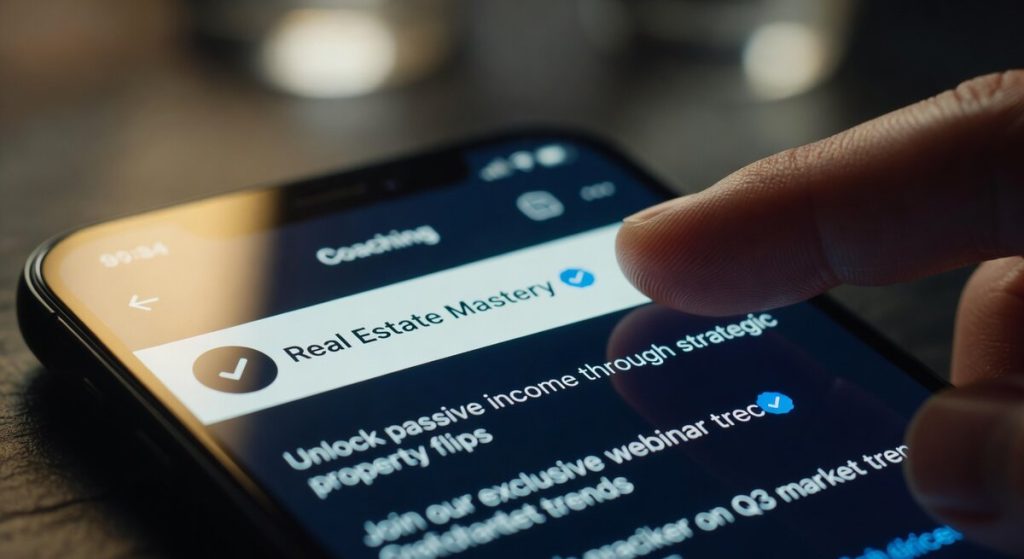
Search “real estate coaching” on Instagram, Facebook, TikTok, or YouTube and you will find thousands of accounts promising six-figure incomes, easy deals, and the secret formula that nobody else is teaching. Some of these accounts represent legitimate, established companies. Many do not. The challenge for any aspiring real estate investor is figuring out which is which before you spend money you cannot afford to lose on a coaching program that delivers nothing.
At Real Estate Sales LLC, we have been in business for 19 years and we maintain an active presence across every major social media platform. We have also seen what the bad actors do — the fake testimonials, the rented mansions, the cherry-picked screenshots, the disappearing accounts. In this post, we want to give you a practical guide for evaluating any real estate coaching program you encounter on social media, with specific red flags to watch for and green flags that suggest legitimacy.
Why Social Media Vetting Matters in 2026
Real estate coaching has become one of the most saturated niches on social media. According to industry estimates, there are now thousands of accounts on Instagram alone claiming to teach real estate investing. The barrier to entry is essentially zero — anyone with a phone, a rented Lambo, and a few stock photos can position themselves as a “real estate expert” overnight.
The result is a marketplace where genuine, experienced coaches are competing for attention with people who closed one deal six months ago and are now selling courses about it. Without a clear framework for evaluating these programs, even smart investors get fooled.
Red Flags: Signs a Coaching Program Is NOT Legit
These are the warning signs we see most often. If a coaching program shows multiple red flags, walk away — there are too many legitimate options to risk your money on a program that has these issues.
1. The Account Was Created Recently
Click on the profile and check when they joined the platform or when their first post was published. If a “real estate expert” only started posting six months ago, they have not been doing this long enough to have meaningful insights to teach. Real estate is a long-game industry. Anyone who claims to have mastered it in under a year either got lucky once or is making it up.
2. All Their Success Stories Are Anonymous
Legitimate coaching programs have named clients with verifiable stories. If every testimonial is “John D.” or “happy client” with no last name, no photo, no city, and no specific timeline, you cannot verify any of it. Real students are happy to share their full names because they want to celebrate their wins. Anonymous testimonials are a major red flag.
3. They Show Off Wealth Constantly
If the entire feed is luxury cars, private jets, watches, mansions, and stacks of cash, that is marketing — not education. Real successful investors are usually busy doing deals, not photographing their cars. The flashier the lifestyle content, the less likely it is that the person actually closes deals consistently. Wealth display is the easiest part of the scam to fake.
4. They Pressure You to Buy Immediately
“Only 5 spots left!” “Price doubles tomorrow!” “Don’t miss this once-in-a-lifetime opportunity!” These are pressure tactics designed to bypass your critical thinking. A legitimate coaching program will let you think it over, ask questions, and read reviews before you commit. If you feel rushed, that is by design — and it should be your cue to walk away.
5. Their Comments Are All Generic Praise
Scroll through the comments on their posts. If every comment is “🔥🔥🔥” or “Amazing content!” with no specific feedback, the engagement is likely fake or bought. Real audiences leave specific questions, share their own experiences, and have nuanced conversations. Empty hype comments are a sign of paid engagement.
6. There’s No Way to Talk to a Real Person
Try to find a phone number, an email address, a physical address, or a contact form. If the only way to reach them is through DMs or a sales funnel that requires you to fill out a form before anyone responds, that is a problem. Legitimate businesses have multiple, transparent contact methods.
7. They Have No BBB Profile or BBB History
Search the company name on the Better Business Bureau website. Even if they are not BBB accredited, legitimate companies have profiles with some history. If you cannot find any record of them on BBB, or if they have a brand new BBB profile with zero history, that is suspicious.
8. Their Website Looks New or Unprofessional
Check the company’s website. Tools like archive.org can show you when the site was first created and how it has evolved. A legitimate coaching company should have a website that has been online for several years, with consistent branding, real photos of the team, and substantive content beyond just sales pages.
9. They Refuse to Give Specific Numbers
When you ask about typical results, do they give vague answers like “It depends on you” or specific data like “Our students average X deals in their first year”? Legitimate companies track their results and can give you real numbers. Vague answers usually mean they do not have any data — or the data is not flattering.
10. The Account Suddenly Disappears or Rebrands
If you can find evidence that the same person has run multiple coaching programs under different names, that is a huge warning sign. Real businesses build reputation over years. Scammers cycle through brand names whenever the complaints pile up.
Green Flags: Signs a Coaching Program IS Legit
Now flip the script. Here are the positive signals that indicate a coaching program is worth your time and trust.
1. They Have Years of Active Social Media History
Legitimate companies maintain consistent social media presence over years. Their content evolves, their student stories accumulate, and their style matures. A profile with 5+ years of consistent posting tells you they are committed to the long game.
For reference, here are our active profiles where you can see this kind of long-term consistency:
- Facebook — Real Estate Sales LLC
- Instagram — @realestatesalesllc
- YouTube — Real Estate Sales LLC
- Pinterest — Real Estate Sales LLC
- LinkedIn — Real Estate Sales LLC
2. Real Named Clients With Documented Stories
Look for testimonials that include first and last names, specific dollar amounts, real timelines, and detailed context. The more specific the story, the more likely it is to be genuine. You can read examples on our testimonials page and our reviews page.
3. Educational Content That Actually Teaches
Does the company share useful information for free, or is every post a sales pitch? Legitimate programs are confident enough to give away genuine value because they know their full program is worth paying for. If you can learn something practical from their free content, that is a good sign.
4. Transparent Pricing and Program Structure
Legitimate programs are upfront about what they cost and what you get. If you have to talk to a sales rep three times before anyone will tell you the price, that is a red flag. Real Estate Sales LLC publishes its program structure, mentions costs in interviews and articles, and answers pricing questions directly when you call.
5. Founders Are Visible and Identifiable
You should be able to find the names of the people running the company, see their faces, learn their backgrounds, and verify their credentials. Brian and Amy Keith founded Real Estate Sales LLC 19 years ago and have been the public faces of the company throughout that time. Their backgrounds are public, their LinkedIn profiles are real, and they regularly appear in industry publications.
6. Consistent Messaging Across Platforms
If a coaching program says one thing on Instagram, something different on Facebook, and a third version on their website, that is incoherent. Legitimate businesses have a clear value proposition and stick with it across every channel.
7. Featured in Independent Publications
Has the company been profiled by industry magazines, news outlets, or franchise publications? These outlets do their own research before they write about a company. Being featured in places like Franchise Dictionary Magazine or Franchise Help is a credibility signal that comes from outside the company itself.
8. Real Reviews on Independent Platforms
Check Google Reviews, Yelp, BBB, and forum sites. The reviews do not have to all be positive — that would actually be suspicious. Look for a mix of perspectives, with the company responding professionally to criticism. That is the mark of a real business.
9. They Have a Long-Standing Phone Number and Address
A real business has a real address and a phone number that has been the same for years. You can call and talk to a human. You can mail them a letter. They are findable.
Real Estate Sales LLC has been at 410 South Rampart, Suite 390, Las Vegas, NV 89145 for years, with the same phone number: 1-800-644-1630. You can verify this through public records.
10. They Welcome Questions and Skepticism
When you ask hard questions, how do they respond? Do they get defensive, dodge, or shut down the conversation? Or do they engage thoughtfully and provide real answers? Legitimate programs welcome scrutiny because they have nothing to hide.
How to Do Your Own Vetting in 30 Minutes
Here is a practical checklist you can use to evaluate any real estate coaching program in about 30 minutes:
- Check the company’s website on archive.org to see how long it has existed and how it has evolved
- Search the company name + “review” on Google to see what comes up
- Search the company name on BBB and read any complaints and responses
- Find their social media profiles and check the post history dates
- Look at their testimonial stories — are they named, dated, and specific?
- Find a phone number and actually call it
- Search forums like BiggerPockets for honest discussions about the program
- Check if the founders have public LinkedIn profiles with consistent work history
- Read independent articles about the company in industry publications
- Trust your gut — if something feels off, it probably is
Why We Maintain a Strong Social Media Presence
Our social media accounts are not just marketing channels. They are part of how we maintain transparency and stay connected with our students and prospects. We want anyone considering Real Estate Sales LLC to be able to see what we have been posting for years, what our students are saying, and what kind of content we share.
If you are evaluating us against other programs, do exactly what we recommend in this article. Look at our post history. Check our testimonials. Verify our address and phone number. Read the independent reviews. Search for negative content as well as positive. Then make an informed decision.
Ready to Take the Next Step?
If you have done your due diligence on Real Estate Sales LLC and you are ready to learn more, here is how to move forward:
- Watch our free webinar to see how the FLIP CHEAP HOUSES™ system works
- Read all of our verified client reviews
- Watch coach interviews with our students
- Browse our complete FAQ
- Contact us directly or call 800-644-1630 to talk to our team
The real estate coaching industry has plenty of bad actors. Do your homework, ask hard questions, and trust your judgment. We are confident that any honest evaluation will lead you to the right program for your goals — and we believe Real Estate Sales LLC will earn your trust if you give it a fair look.