Why Direct Mail Still Works
In a world dominated by digital marketing, direct mail might seem outdated. But for real estate investors, it remains one of the most effective lead generation strategies available. Why? Because motivated sellers — homeowners facing foreclosure, divorce, probate, or financial hardship — are often older, less tech-savvy, and more likely to respond to a physical piece of mail than a Facebook ad.
Direct mail also cuts through the noise. Most people receive dozens of emails and see hundreds of online ads every day. A well-crafted letter or postcard that arrives in their physical mailbox stands out. It feels personal. And when someone is desperate to sell their home, that personal touch can make all the difference.
At Real Estate Sales LLC, direct mail has been a cornerstone of our lead generation system. Here is how to use it effectively.
Building Your Mailing List
The success of your direct mail campaign depends almost entirely on who you mail to. A brilliant letter sent to the wrong audience is wasted money. Here are the most productive lists for real estate investors:
Absentee owners. Property owners who do not live at the property address are often landlords or people who have moved away. Many are tired of managing a property from a distance and are open to selling.
Pre-foreclosure and notice of default. Homeowners who have received foreclosure notices are under extreme time pressure. They need solutions fast, and your offer to buy their property can be a lifeline.
Probate. When a property owner passes away, the heirs often inherit a house they do not want or cannot afford to maintain. Probate properties are among the best leads for investors because the heirs are typically motivated to sell quickly.
Tax delinquent owners. Homeowners who have fallen behind on property taxes may be experiencing financial difficulties. They are often willing to sell below market value to resolve their tax situation.
High equity owners. Properties with significant equity give owners more flexibility on price. A homeowner who owns their property free and clear can accept a lower offer because they do not have a mortgage to pay off.
Expired listings. Properties that were listed on the MLS but failed to sell may have motivated owners who are frustrated with the traditional selling process. They may be open to a direct offer.
Types of Mail Pieces
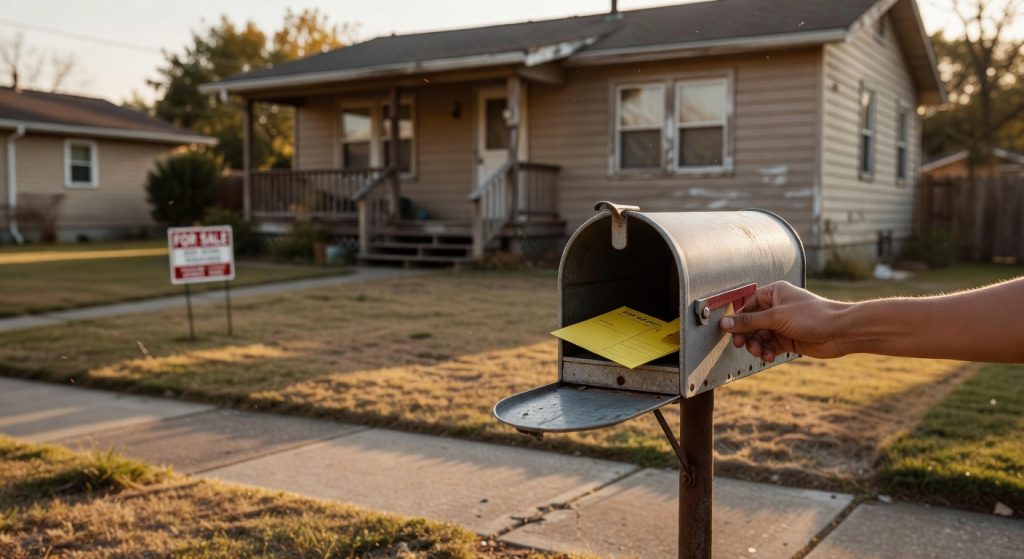
Yellow letters. Handwritten (or handwritten-style) letters on yellow legal pad paper. They look personal and have high open rates because they do not look like junk mail. The message is simple and direct: you are interested in buying their property.
Postcards. Postcards are cheaper to print and mail, and they do not need to be opened — your message is immediately visible. They work well for volume campaigns and follow-up touches.
Professional letters. Typed letters on company letterhead project credibility and professionalism. They work well for probate and higher-value properties where homeowners may be wary of informal approaches.
Greeting cards. Cards with a brief, personal message inside have very high open rates. They cost more per piece but can outperform other formats in response rate.
Crafting Your Message
Keep it simple, direct, and personal. Here are the key elements:
Address the owner by name. Personalization dramatically increases response rates. Never use “Dear Homeowner” or “To Current Resident.”
Reference the specific property. Mentioning the property address shows you are serious and have done your research.
State your purpose clearly. Tell them you are interested in buying their property. Do not be vague or try to disguise your intention.
Emphasize benefits. Fast closing, no repairs needed, no agent commissions, cash offer. Focus on what matters to a motivated seller.
Include a clear call to action. Tell them exactly what to do next — call your phone number, visit your website, or text you.
Keep it short. Motivated sellers do not want to read an essay. Get to the point in three to five sentences.
The Follow-Up System
Here is the truth about direct mail that most beginners do not understand: most of your deals will come from follow-up touches, not the first mailing. Studies show that it takes an average of five to seven contacts before a prospect takes action.
Create a multi-touch campaign. Plan to mail the same list five to seven times over several months. Vary your mail pieces — start with a yellow letter, follow up with a postcard, then another letter in a different format.
Track your results. Use unique phone numbers or codes for each campaign so you can track which lists and mail pieces generate the most responses. This data is invaluable for optimizing your campaigns over time.
Respond quickly. When a motivated seller calls, answer the phone or return their call within minutes. Speed matters — if you do not respond quickly, they will call the next investor who mailed them.
Budgeting for Direct Mail
Direct mail is not free, but it does not have to break the bank. Here is a realistic budget breakdown:
Cost per piece: Postcards run $0.50 to $1.00 each (printing plus postage). Yellow letters cost $1.00 to $2.00 each. Professional letters with envelopes cost $1.50 to $3.00 each.
List costs: Mailing lists typically cost $0.05 to $0.15 per record from services like ListSource, PropStream, or your local county records.
Suggested starting budget: $500 to $1,000 per month will allow you to mail 500 to 1,000 pieces monthly — enough to generate leads if your list and message are dialed in.
Expected response rate: A well-targeted campaign typically generates a 1 to 3 percent response rate. That means 500 pieces might produce 5 to 15 calls, of which 1 to 3 might become viable deals.
Measuring ROI
The real metric that matters is cost per deal, not cost per lead. If you spend $3,000 on direct mail over three months and close one wholesale deal for a $10,000 assignment fee, your return on investment is over 200 percent.
Track every dollar you spend and every deal that results from your campaigns. Over time, you will know exactly which lists, mail pieces, and messages produce the best returns — and you can scale what works.
Get Expert Guidance
Direct mail is a skill that improves with experience and data. At Real Estate Sales LLC, we teach our students proven marketing systems that generate consistent leads — including direct mail templates, list strategies, and follow-up sequences that have been tested and refined over years of real-world investing.
Ready to build a lead generation machine? Register for our free Flip Cheap Houses webinar and discover the complete system our investors use to find, negotiate, and close profitable deals.